Stye relief guide
Fast online stye treatment & prescriptions $59 same-day eye care
Woke up with a painful, swollen bump on your eyelid? Here’s the deal on stye symptoms, what causes it, how erythromycin ointment helps, and how to get checked online today.
Text-based visit
GA, NC, AZ + licensed states

By Chris Woods, MSN, APRN, FNP-C, AGACNP-BC
Licensed Nurse Practitioner · Double board-certified · Verify on NPI Registry
Eyelid health guide
You wake up, look in the bathroom mirror, and there it is: a painful, swollen, red bump right on the edge of your eyelid. It hurts to blink, it feels tender to the touch, and honestly, it is cosmetically embarrassing. Your brain immediately starts scanning your calendar, wondering how to get rid of this thing fast before major upcoming meetings or weekend events.
Eye issues have a way of causing immediate stress because they are so visible. That is exactly why stye treatment is one of the most common reasons folks look for same-day online care. You do not want to wait three days to be seen just to get a straightforward prescription ointment.
Quick answer
A stye (hordeolum) is a localized bacterial infection of an oil gland in the eyelid, usually caused by staphylococcus bacteria. While many minor styes drain on their own within a week using warm compresses, a persistent or highly painful stye can be treated with prescription antibiotic eye ointments, like erythromycin ophthalmic ointment, when appropriate.
NPCWoods provides secure, photo-upload text triage for eyelid concerns for a $59 flat fee. A licensed clinician reviews your photos and history, and if a prescription is medically appropriate, we send it to your local pharmacy for same-day pickup.
What is actually going on with an eyelid stye?
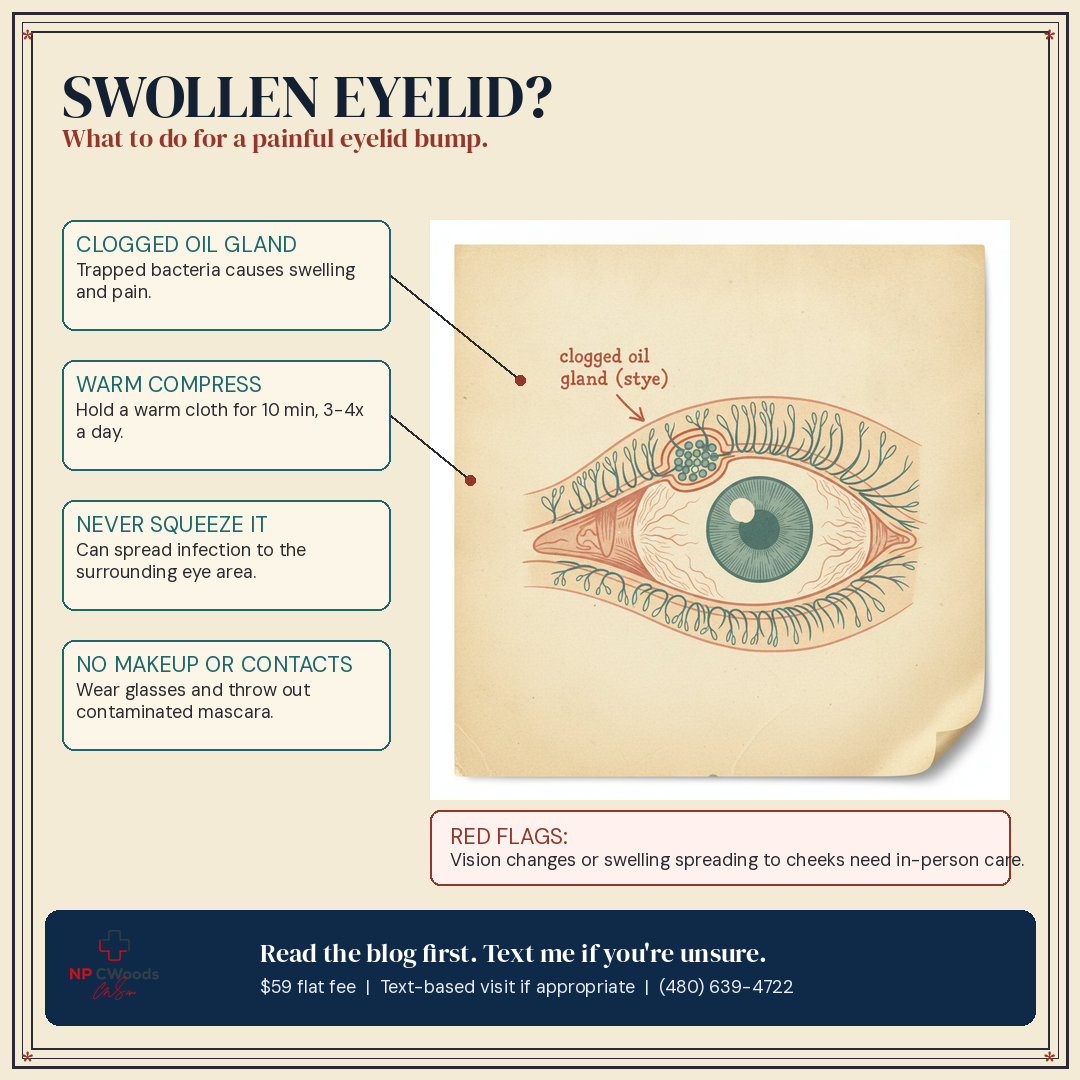
If you want to understand a stye, the easiest analogy is a pimple. Your eyelids are lined with dozens of tiny oil glands (especially the meibomian glands near the base of your eyelashes). These glands produce the oils that keep your tears from evaporating too quickly. Sometimes, dead skin cells, oil, or debris clog a gland. When that plug traps normal skin bacteria—specifically staphylococcus—inside the gland, it swells up and forms a localized pocket of infection.
Clinically, we group styes into two types:
- External hordeolum: This is the most common kind. It forms right at the base of an eyelash and looks like a classic red bump or pimple pointing outward on the edge of the lid.
- Internal hordeolum: This is an infection of a gland deeper inside the eyelid. It points toward the eyeball side of the lid, causing the entire eyelid to swell up and feel heavy or bruised.
Both types cause localized tenderness, swelling, redness, and tearing. You might feel like there is something stuck in your eye, or notice crusting along the lid margin in the morning.
Clues at a glance
Symptoms
Eyelid bump, swelling, localized tenderness, redness, pain when blinking, and tearing.
Causes
Blocked eyelash oil glands (meibomian glands) combined with normal staph skin bacteria.
What to avoid
Never squeeze or pop a stye. Remove contact lenses and avoid all eye makeup during active infection.
First line care
Warm washcloth compress for 5-10 minutes, 3-4 times daily to encourage natural drainage.
What most people try first (and what to avoid)
When a stye first starts popping up, your first line of defense is conservative home care. The single best thing you can do is apply a warm compress. Take a clean washcloth, run it under warm water (warm, not hot enough to burn your delicate eyelid skin), wring it out, and hold it gently against your closed eye for 5 to 10 minutes. Do this 3 to 4 times a day. The warmth helps liquefy the trapped oils and encourages the stye to open and drain naturally.
But here is where a lot of people go wrong, and it is a major safety warning: never squeeze, pop, or needle a stye. I know it looks like a pimple, but squeezing an eyelid infection can push the bacteria deeper into the surrounding delicate tissues of the orbit, which can turn a simple localized bump into a severe, spreading skin infection called periorbital cellulitis. Let it drain on its own.
What actually fixes it (prescription options)
For many people, warm compresses are enough to get the stye to drain and heal within a few days. But if the stye is highly painful, is not improving after 48 hours, or is causing significant swelling, a prescription antibiotic may be considered.
The most common medical treatment for a localized stye is erythromycin ophthalmic ointment. Erythromycin is a macrolide antibiotic that works by stopping the growth of bacteria. Because it is an ointment rather than a liquid drop, it has a thick consistency. This means it stays in contact with the infected eyelid margin longer, making it highly effective for localized gland infections.
To apply it, you pull down your lower eyelid to create a small pocket and squeeze a thin ribbon of ointment along the inside of the lid. It will temporarily blur your vision for a few minutes, which is why many folks prefer using it right before bed. Other options like polymyxin B-trimethoprim (Polytrim) drops are sometimes used, but for a localized hordeolum, an ointment that sits directly on the infected gland is often the preferred clinical route.
Want the fuller guide?
You can read the erythromycin eye ointment guide, the pink eye guide, and the pricing page.
How NPCWoods handles stye triage
If you have a painful stye and do not want to wait around in an urgent care lobby, NPCWoods is built to handle this safely and quickly. We use a photo-upload text triage process. You do not need to download an app or get on a video call.
You fill out a quick, secure form about your symptoms, medical history, and allergies, and upload a close-up photo of the affected eyelid. A double board-certified nurse practitioner reviews your case. If the case is straightforward, I will write a prescription (like erythromycin ointment) and send it to your local pharmacy for same-day pickup.
The visit is a $59 flat fee. There are no hidden fees, no surprise bills, and no paperwork hassles. If I review your case and determine that your stye looks complicated or requires in-person care, I will tell you clearly and direct you to the right place.
When a stye needs in-person evaluation
While most styes are routine, the eyes are sensitive real estate. You should seek prompt in-person care if you notice any of these warning signs:
- Your vision is affected (blurriness, double vision, or difficulty seeing)
- The redness and swelling spread from the stye to your entire eyelid, cheek, or face
- The eyeball itself becomes highly red, bloodshot, or painful
- You have a fever, chills, or feel generally sick
- You have a weakened immune system
- The stye does not improve at all after 48 to 72 hours of self-care
Red flags
Spreading facial swelling, eye pain, vision changes, or fever are clear red flags that deserve immediate, in-person clinical evaluation.
The bottom line
Waking up with a stye is painful and frustrating, but it is highly treatable. Start with warm compresses, take out your contacts, and do not squeeze it. If you need a clinical review and a prescription to get it cleared up, we can handle the evaluation by text today.
Soft next step
Need a clinical review and stye prescription?
Text Chris what happened, upload a photo of your eyelid, and get evaluated secure by text today. Same-day prescription sent to your local pharmacy if appropriate.
$59 flat fee if a visit is appropriate. No app download. No video call required for most simple visits.
This article is for education only and does not replace a clinical evaluation.