
Written and medically reviewed by Chris Woods, MSN, APRN, FNP-C
This article reflects Chris’s real clinical experience treating common urgent-care conditions through NPCWoods Telemedicine. Content is reviewed for accuracy, updated over time, and paired with clear guidance on when text-based care is appropriate and when in-person care matters more.
Licensed Nurse Practitioner. Licensed in AZ, CO, GA, ID, IA, MT, NV, NM, NC, OR, UT. NPI 1285125468.
Published April 10, 2026. Last reviewed and updated April 14, 2026.
You text Chris directly. No AI triage, no call center, and no copy-paste handoff between strangers.
This article is educational only. For chest pain, trouble breathing, severe dehydration, confusion, or other emergencies, call 911 or seek urgent in-person care.

Do I Need Antibiotics for a Sinus Infection? An NP Explains
By Chris Woods, MSN, APRN, FNP-C, PMHNP-BC | Updated April 2026
Day 12 of feeling like your face is full of concrete. You’ve gone through two boxes of tissues. Your teeth hurt. Your head is pounding. You’re mouth-breathing at work and honestly, you’re just over it.
And now you’re sitting here Googling, “Do I actually need antibiotics, or is this just gonna go away on its own?”
I get it. That’s a totally fair question. And the answer is: it depends — but there are some really clear guidelines I use every single day as a double board-certified Nurse Practitioner to figure this out. Let me walk y’all through it.
The 10-Day Rule: When Antibiotics Actually Make Sense
Here’s the deal. The Infectious Diseases Society of America (IDSA) has a straightforward rule that I follow in my practice: if your symptoms have lasted 10 days or more without getting better, it’s time to consider antibiotics.
But there’s another pattern that’s a big red flag — the “double worsening.” That’s when you start feeling better after a few days, and then suddenly get worse again. New fever, worse congestion, the pain cranks back up. That U-shaped curve is your body telling you a bacterial infection has set up shop on top of what was probably a virus.
There’s also the severe onset scenario: if you get hit with a high fever (102°F+) AND thick, colored nasal drainage right from the jump — lasting at least 3-4 days — that points to bacterial from the start.
If none of those boxes are checked? Your sinuses are almost certainly fighting off a virus, and antibiotics won’t touch it. I know that’s not what you want to hear at 2 AM, but it’s the truth! Learn more about how sinus infections work and what to expect.
Viral vs. Bacterial: How to Tell the Difference
This is the question I get asked the most. And honestly? You can’t tell 100% without a culture (which almost nobody does for a sinus infection). But here’s what I look at:
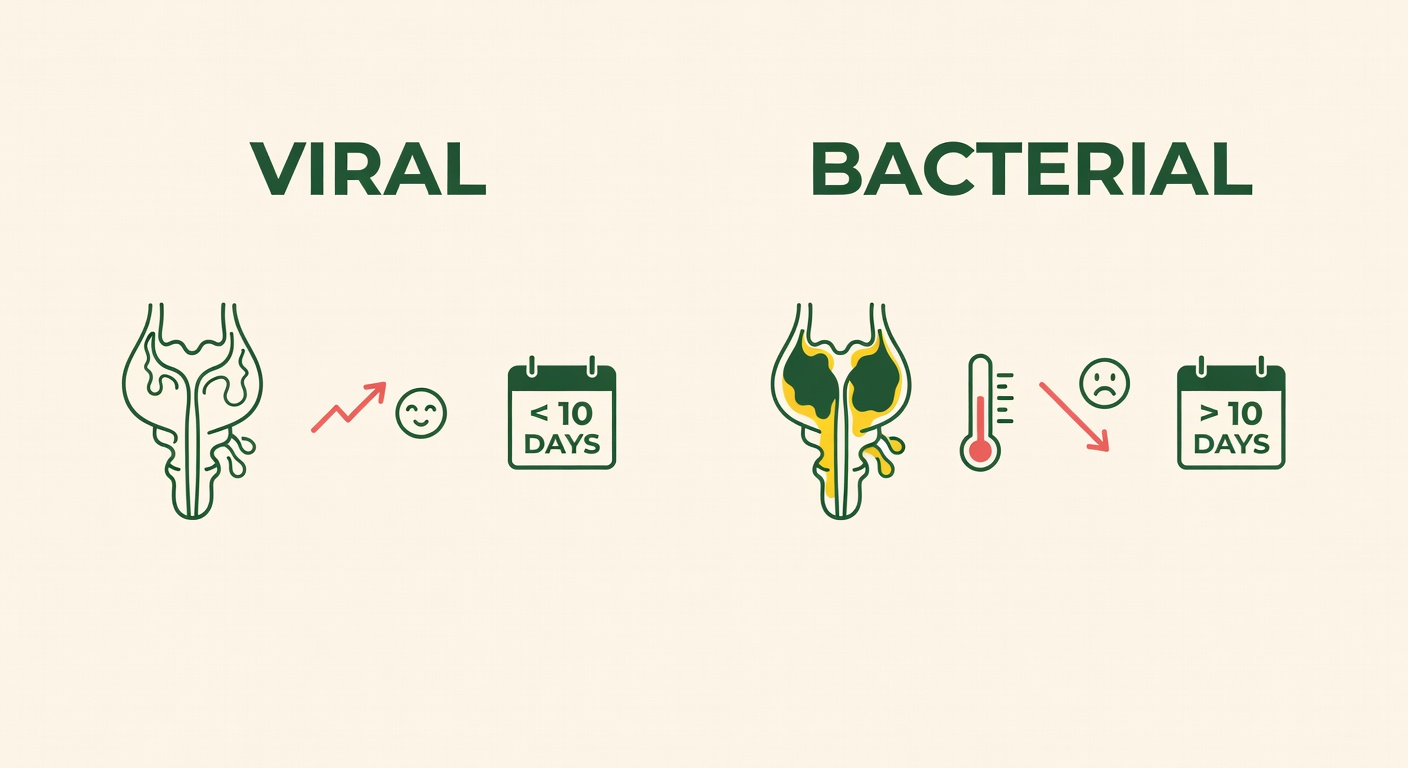
Viral Sinus Infection (Most Common!)
- Symptoms gradually improve after days 5-7
- Clear or whitish nasal drainage
- Low-grade or no fever
- Often follows a cold
- Duration under 10 days
Bacterial Sinus Infection
- Symptoms last 10+ days without improvement
- Thick yellow or green drainage
- Fever 102°F+ (especially with “double worsening”)
- Facial pain/pressure that’s one-sided or severe
- Symptoms that improve then suddenly get worse
Here’s a stat that surprises people: up to 98% of sinus infections start as viral. That means the vast majority don’t need antibiotics at all. Only about 2-10% turn bacterial. So if you’re on day 4 with some yellow snot, hang tight — your body is probably handling it!
And I know — yellow or green mucus feels like it HAS to mean bacterial. But that’s actually a myth! The color comes from white blood cells fighting the infection, and that happens with viruses too. Color alone doesn’t tell me much. It’s the timeline and pattern that matter most.
When You DO Need Antibiotics: The Clear Criteria
Alright, so here’s when I’m reaching for that prescription pad (well, my phone — more on that in a sec). You likely need antibiotics if:
- Persistent symptoms — 10+ days with no improvement. Congestion, facial pain/pressure, and nasal drainage that just won’t quit.
- Double worsening — you started getting better, then got notably worse. New fever, increased pain, drainage changes.
- Severe onset — high fever (102°F+) with purulent nasal discharge for 3-4+ consecutive days from the beginning.
If you check one of those boxes, it’s time to talk to a provider. And that’s something I can help with — check out our full sinus infection treatment page to see exactly how we handle it.
Which Antibiotics Work Best for Sinus Infections?
When antibiotics are indicated, I don’t go straight for the big guns. Guidelines say to start simple:
- Augmentin (amoxicillin-clavulanate) — this is the true first-line treatment per current IDSA guidelines. The clavulanate covers bacteria that have learned to resist plain amoxicillin, which is why it’s preferred now. Typically 5-10 days depending on your situation.
- Amoxicillin — still a reasonable option in some cases, especially for mild symptoms in areas with low antibiotic resistance. It’s cheap, effective, and well-tolerated. But Augmentin has become the standard starter.
- Azithromycin (Z-pack) — I’ll be real with y’all — Z-packs are over-prescribed for sinuses, and current guidelines actually recommend against them as a go-to because of high resistance rates. If you have a penicillin allergy, doxycycline is often the better choice. But every situation is different, and that’s exactly why you want a real clinician making the call.
I always tell folks: the right antibiotic depends on your history, allergies, and what’s going on right now. That’s why talking to an actual clinician matters — even if it’s by text!
How NPCWoods Handles Sinus Infections (By Text, Same Day)
Here’s how this works at NPCWoods — and why people love it:
- Text us at (480) 639-4722 and tell me what’s going on — how long you’ve been sick, your symptoms, allergies, the whole picture.
- I personally review your message (no bots, no call centers — it’s literally me, Chris).
- If antibiotics are appropriate, I send a prescription to your pharmacy the same day.
- If they’re not needed, I’ll tell you exactly what to do instead. No judgment, just straight answers.
It’s $59. That’s it. No hidden fees, no follow-up charges, no membership. One visit, one flat price. Got questions? Check the FAQ.
Home Remedies That Actually Help While You Wait
Whether you’re riding out a virus or waiting for antibiotics to kick in, these actually make a difference:
- Nasal saline irrigation — a NeilMed or neti pot is your best friend right now. Flush those sinuses 2-3 times a day. It’s gross but it works!
- Steam inhalation — hot shower, bowl of hot water with a towel over your head, whatever gets warm steam into those passages.
- Stay hydrated — water, warm tea, broth. Thin out that mucus.
- OTC decongestants — pseudoephedrine (Sudafed) or oxymetazoline spray (Afrin) for short-term relief. But don’t use Afrin more than 3 days — rebound congestion is real.
- Pain relief — ibuprofen (Advil) works great for sinus pain and inflammation. Acetaminophen (Tylenol) if you can’t take ibuprofen.
- Sleep elevated — prop yourself up with an extra pillow. Gravity helps drainage.
These aren’t going to cure a bacterial infection, but they’ll make the wait a whole lot more bearable. And if it IS viral, this is basically the treatment plan anyway!
One more thing — skip the essential oils and random supplements you see on TikTok. I’m not saying some of that stuff can’t feel nice, but there’s zero clinical evidence they treat a sinus infection. Stick with what’s proven. Your sinuses will thank you!
The Bottom Line
Most sinus infections are viral and will clear up on their own. But if you’ve hit the 10-day mark, experienced double worsening, or got slammed with a high fever and colored drainage from day one — you probably need antibiotics. And that’s totally okay! That’s what they’re there for.
You don’t have to sit in urgent care for two hours to find out. You don’t have to wait three weeks for an appointment. You can literally text me from your couch right now.
Sources & Clinical References
This article is for educational purposes only and does not replace professional medical advice. If you’re experiencing symptoms, text (480) 639-4722 to speak with a licensed nurse practitioner.
- Chow AW, Benninger MS, Brook I, et al. IDSA Clinical Practice Guideline for Acute Bacterial Rhinosinusitis in Children and Adults. Clinical Infectious Diseases. 2012;54(8):e72-e112. doi:10.1093/cid/cis370
- Rosenfeld RM, Piccirillo JF, Chandrasekhar SS, et al. Clinical Practice Guideline (Update): Adult Sinusitis. Otolaryngology–Head and Neck Surgery. 2015;152(2 Suppl):S1-S39. doi:10.1177/0194599815572097
- Centers for Disease Control and Prevention. Sinus Infection (Sinusitis): Antibiotic Prescribing. cdc.gov/antibiotic-use/sinus-infection.html

Sinus infection dragging on? Let’s fix it.
Text me your symptoms. $59, same-day prescriptions, no surprises.
Text (480) 639-4722This blog post is for informational purposes and does not replace a clinical evaluation. Chris Woods, MSN, APRN, FNP-C, PMHNP-BC, is a double board-certified Nurse Practitioner. NPCWoods provides async telehealth visits for non-emergency conditions.