Written and medically reviewed by Chris Woods, MSN, APRN, FNP-C
This article reflects Chris’s real clinical experience treating common urgent-care conditions through NPCWoods Telemedicine. Content is reviewed for accuracy, updated over time, and paired with clear guidance on when text-based care is appropriate and when in-person care matters more.
Licensed Nurse Practitioner. Licensed in AZ, CO, GA, ID, IA, MT, NV, NM, NC, OR, UT. NPI 1285125468.
Published April 10, 2026. Last reviewed and updated April 24, 2026.
You text Chris directly. No AI triage, no call center, and no copy-paste handoff between strangers.
This article is educational only. For chest pain, trouble breathing, severe dehydration, confusion, or other emergencies, call 911 or seek urgent in-person care.

Text-Based Telehealth vs. Video Telehealth — Which Is Better?
By Chris Woods, NP | April 9, 2026 | 6 min read
For most common conditions — UTIs, sinus infections, strep throat, skin rashes — text-based telehealth is faster, cheaper, and just as clinically effective as video visits. But video has its place too. This guide breaks down both honestly so you can pick what actually fits your situation.
If you’ve searched “telehealth” lately, you’ve probably seen two very different things: platforms where you hop on a video call with a provider, and newer async services where you describe your symptoms by text and get a treatment plan back — no camera required. Both are real medical care. They’re just built for different situations. Let me walk you through how each one works, where each one wins, and where I’d steer you toward the other.
What Is Text-Based Telehealth? (Async)
Text-based telehealth — also called asynchronous telehealth or store-and-forward care — works like this: you describe your symptoms in a secure text intake form, attach a photo if relevant (skin conditions, rashes, etc.), and a licensed clinician reviews your case and responds with a diagnosis and treatment plan. No scheduling. No waiting room. No camera.
At NPCWoods, the whole thing runs through a simple text conversation. You text your symptoms, I review them, and you get a treatment plan — often including a prescription sent to your pharmacy — without ever opening a video app or rearranging your schedule. It’s $59, flat. That’s it.
Async telehealth is ideal for conditions with clear, recognizable symptom patterns. Think: the burning when you pee that you’ve had before. The sinus pressure that hits every fall. The strep that’s going around your kid’s school. These don’t require a live face-to-face conversation — they require the right clinical questions and a knowledgeable provider who knows what to do with the answers.
What Is Video Telehealth? (Synchronous)
Video telehealth is the more traditional approach: you book an appointment, join a virtual waiting room, and then have a live 10-15 minute video visit with a provider. It looks and feels a lot like an in-person clinic visit, just on a screen.
Video platforms like Teladoc, MDLive, and many urgent care chains use this model. Some direct-pay clinics do too. The upside is real-time back-and-forth and the ability to visually observe someone — their affect, their breathing, how they’re holding themselves. For some conditions, that matters. The downside is scheduling, wait times, and needing to be somewhere camera-appropriate.
Head-to-Head: Text-Based vs. Video Telehealth
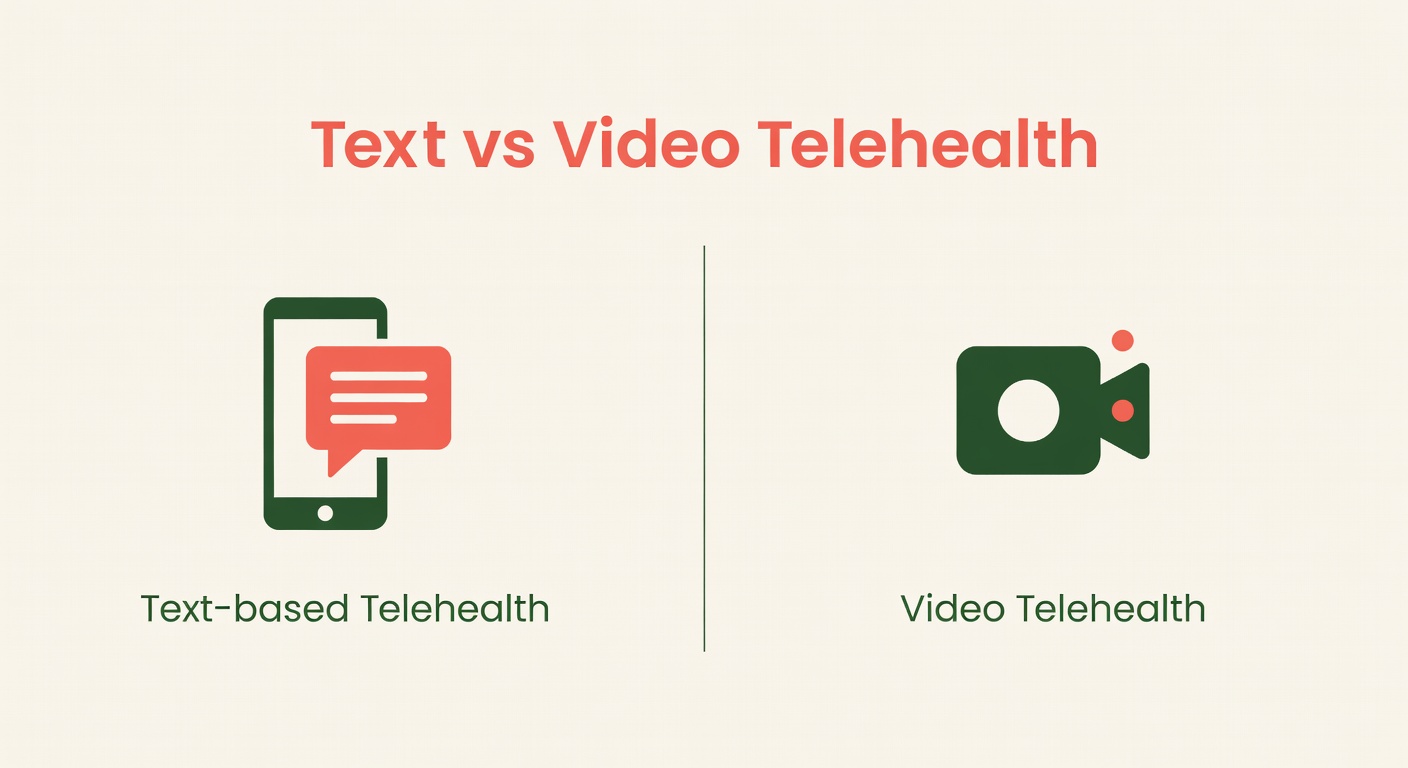
| Feature | Text-Based (Async) | Video (Synchronous) |
|---|---|---|
| Scheduling | None — text anytime | Appointment required |
| Wait time | None | 5–30 min virtual waiting room |
| Visit length | Your pace — respond when ready | 10–15 min live call |
| Cost | $59 (NPCWoods) | $75–$150 typical |
| Privacy | Text from anywhere, discreetly | Need a private room with camera |
| Provider | Same NP every time (NPCWoods) | Usually random rotation |
| Best for | UTIs, sinus, strep, skin, dental, ED | Mental health, complex symptoms, follow-ups needing visual exam |
When Text-Based Wins
Here’s where async telehealth is simply the better tool — not just more convenient, but genuinely the right clinical fit:
- Common, well-characterized conditions. UTIs, sinus infections, strep, cold sores, skin rashes — these have been studied extensively and treated via symptom-based protocols for decades. The evidence for same-day treatment based on symptoms alone is solid. See the full conditions list.
- You’re busy and can’t block off time. No appointment means you text between meetings, during a lunch break, or at 11pm when you finally notice that sinus pressure is turning into something. You don’t have to rearrange your day.
- It’s something you’d rather not say out loud. UTI symptoms, erectile dysfunction, STI concerns, vaginal discharge — these are common, treatable things that a lot of people quietly deal with because they don’t want to say them to a face on a screen. Text gives you that privacy.
- You’re a parent with small kids at home. Finding a private, quiet room for a video call with a toddler or baby around is almost impossible. Texting your symptoms while they nap or play next to you is entirely doable.
- You want the same provider who knows your history. At NPCWoods, every visit is with me — not whoever’s on call. That continuity matters, especially if you’re a returning patient with context I already know.
- Cost is a factor. At $59 per visit with no recurring fees, text-based care at NPCWoods is meaningfully less expensive than most video platforms — and you’re not trading quality for the price difference.
When Video Wins
I’ll be straight with you here. There are situations where video is the better choice, and I’d rather tell you that up front than pretend text-based care handles everything.
- Mental health visits. Therapy and psychiatric care depend heavily on reading affect, tone, body language, and emotional responsiveness in real time. Text strips out most of those signals. Video (or in-person) is the right format here.
- Complex or multi-system symptoms. If you’re describing symptoms across multiple organ systems — say, chest tightness plus shortness of breath plus leg swelling — that warrants a more thorough real-time evaluation, and possibly an in-person visit. Don’t try to text your way through something that complicated.
- Physical exam matters for diagnosis. Ear infections in young children, some abdominal complaints, lymph node evaluation — these benefit from a hands-on or at minimum a real-time visual assessment that text can’t replicate.
- Follow-up care for complex chronic conditions. Managing diabetes, heart failure, or post-surgical recovery involves enough nuance that a live conversation is worth scheduling. Read more about what conditions I see.
If you’re unsure whether your situation is a good fit for text-based care, check the FAQ or just text me — I’ll tell you honestly if you need something else.
What the Clinical Evidence Says
This isn’t just about convenience — the clinical case for symptom-based, async treatment of common conditions is well-established.
The Infectious Disease Society of America (IDSA) guidelines for uncomplicated UTIs explicitly support empiric antibiotic treatment based on symptoms in otherwise healthy, non-pregnant women. No urine culture required for initial treatment in straightforward presentations. Same story for acute bacterial sinusitis — the IDSA guidelines recognize that in appropriate clinical presentations, treatment can and should begin based on symptom criteria without a physical exam.
The CDC has actively encouraged telehealth expansion as a mechanism to deliver timely, evidence-based care — particularly for common acute conditions where delays in treatment worsen outcomes. The AMA has similarly published implementation guidance supporting async telehealth as a legitimate and efficient model for appropriate patient populations.
In short: for conditions with clear symptom patterns and established clinical criteria, the evidence supports treating through text just as confidently as through a video call. What matters is the clinical reasoning applied to the information — not the medium it traveled through.
You can also see how text-based care stacks up against in-person options in my comparison of telehealth vs. urgent care.
Why NPCWoods Chose Text-Based Care
I’m a double board-certified Nurse Practitioner. I spent years seeing patients in-clinic and via video, and what I kept noticing was this: the people who needed me most were the ones least likely to make an appointment. The parent who didn’t have time to sit on hold. The young woman who felt embarrassed about her symptoms. The person who needed care at midnight on a Tuesday.
Text-based async care removes the friction from getting help. You don’t have to perform being sick — you just describe what’s happening and let me do the clinical work. And for the conditions I treat, the clinical quality doesn’t suffer. You still get a real assessment from a real clinician, a thoughtful treatment plan, and a prescription sent straight to your pharmacy.
I built NPCWoods to be the kind of practice I’d want to use myself — no waiting, no overhead, no nonsense. Just good care, fast, at a price that doesn’t make you wince. Learn more about why I built it this way.

Ready to give it a try?
Text your symptoms now. No appointment. No waiting room. $59 flat.
Text (480) 639-4722Double board-certified NP | Same provider every visit | Arizona & beyond
Sources & Clinical References
- Gupta K, et al. “International Clinical Practice Guidelines for the Treatment of Acute Uncomplicated Cystitis and Pyelonephritis in Women.” Clinical Infectious Diseases 52(5):e103-e120. Infectious Diseases Society of America (IDSA), 2011.
- Chow AW, et al. “IDSA Clinical Practice Guideline for Acute Bacterial Rhinosinusitis in Children and Adults.” Clinical Infectious Diseases 54(8):e72-e112. Infectious Diseases Society of America (IDSA), 2012.
- Centers for Disease Control and Prevention (CDC). Telehealth guidance on delivery and access for chronic disease management and acute care. CDC, updated ongoing.
- American Medical Association (AMA). “AMA Telehealth Implementation Playbook.” AMA, 2020. Guidance on implementing telehealth including asynchronous/store-and-forward models.
This article is for educational purposes only and does not replace professional medical advice. Both text-based and video telehealth have appropriate uses — consult a licensed provider to determine what’s right for your situation. For non-emergency symptoms, text (480) 639-4722 to speak with a licensed nurse practitioner.